
Vehicle diagnostics used to work like a doctor who only examines patients after they’ve collapsed. The check engine light comes on, the truck goes to the shop, a technician plugs in a scan tool, reads the diagnostic trouble code, and starts working backward from the symptom to the cause. By the time that process starts, the problem has already happened.
The DTC system, the standard onboard diagnostic framework that’s been in every vehicle since OBD-II became mandatory in 1996, was designed for this. It detects when a measured parameter falls outside a predetermined threshold and throws a code. It works. But it has a fundamental limitation that’s become more consequential as vehicles and fleet operations have gotten more complex.
A DTC fires when a problem has already reached a severity level that trips a threshold. It doesn’t tell you when a problem is developing. It doesn’t warn you that a component is degrading gradually. And it often can’t distinguish between a failing sensor and a failing system, which leads to misdiagnosis, wasted parts, and repeat shop visits. That gap between “something is trending wrong” and “the code finally fires” is typically three to six weeks. AI-based diagnostics exist to fill that gap.
What AI diagnostics actually does differently
The foundational difference between traditional OBD diagnostics and AI-based diagnostics comes down to one thing: baselines.
A DTC system works on fixed thresholds. If coolant temperature exceeds 230 degrees, throw a code. If fuel pressure drops below X PSI, throw a code. These thresholds are the same for every truck of that model, regardless of age, mileage, operating conditions, or how the truck is actually being used.
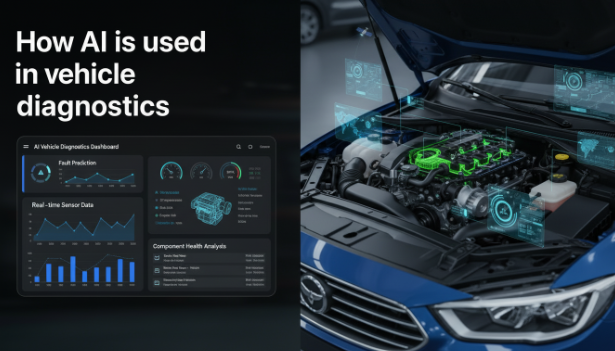
AI diagnostics builds a baseline for each individual vehicle. It monitors engine temperature, fuel burn rate, oil pressure, exhaust gas temperatures, transmission shift patterns, battery voltage, DEF consumption, and dozens of other parameters continuously over weeks and months. From that data, it learns what “normal” looks like for that specific truck under its specific operating conditions. Not normal for the model. Normal for Truck #14 doing Route 7 with 42,000 pounds of cargo in July heat.
When readings start drifting from that individual baseline, even subtly, the AI flags it. A cooling system running 3-4 degrees hotter than its own historical average doesn’t trigger any DTC. But it does signal that something is changing, maybe a partially clogged radiator, maybe a water pump starting to wear, maybe a thermostat that’s sticking intermittently. The AI doesn’t always know the exact root cause on day one. What it does is identify which subsystem is drifting and how fast, giving the maintenance team weeks of lead time to investigate and schedule a repair.
The practical value shows up in the case studies. A municipal fleet of over 1,400 vehicles, including 90 CNG refuse trucks from three different manufacturers, piloted AI-based predictive diagnostics on their fleet. The system detected faults in 30% of the trucks before any DTCs were triggered. The specific issues caught included accelerator pedal sensor malfunctions, engine coolant temperature problems, and engine misfires across multiple cylinders. All of these would have eventually thrown codes. But by the time a multi-cylinder misfire triggers a DTC, you’re often looking at a $3,000-$5,000 repair instead of the $400 fix that would have handled it three weeks earlier. The municipality estimated savings of $500 per vehicle per month from catching problems at the drift stage instead of the failure stage.
The engine is the easy part
Engine diagnostics gets most of the attention because engine failures are expensive and dramatic. But AI-based vehicle diagnostics has expanded well beyond the engine into subsystems that traditional diagnostics barely touches.
After-treatment systems are a good example. Modern diesel trucks have complex emissions control systems involving diesel particulate filters (DPF), selective catalytic reduction (SCR), and diesel exhaust fluid (DEF). These systems are expensive to repair, critical for emissions compliance, and prone to issues that develop gradually. DEF quality degradation, injection nozzle fouling, and sensor drift can all cause after-treatment problems that won’t throw a code until they’ve already triggered a derate event, which forces the truck into reduced power mode.
AI monitoring of DEF consumption patterns, injection timing, and exhaust temperatures can flag after-treatment issues weeks before a derate event occurs. For a fleet operator, the difference between catching a DEF injector problem during a planned shop visit and dealing with a derated truck on a highway is the difference between a $600 repair and a $6,000 loss in missed delivery plus emergency service.
Battery and charging systems are another area where AI diagnostics has become essential. A failing alternator doesn’t always drop voltage dramatically enough to fire a code. Instead, it undercharges the battery gradually. The battery compensates for a while. Then one cold morning, the truck doesn’t start. AI monitoring catches the declining charge curve weeks before that cold morning happens.
Brake systems benefit from behavioral diagnostics. AI can detect changes in braking efficiency by monitoring deceleration rates relative to brake application force. If a truck is requiring 15% more pedal force to achieve the same deceleration it produced two months ago, that’s a brake system issue developing. No DTC will fire for that. A traditional inspection might catch it during a scheduled check. AI catches it the week it starts.
What a transit fleet learned about diagnostics in real time
The California regional transit agency case is worth looking at because transit operations stress-test diagnostics in ways that long-haul trucking doesn’t.
Transit buses do constant stop-and-go cycles in urban environments. They idle heavily, especially when running air conditioning in summer. They carry variable loads throughout the day. And they can’t be pulled off service easily without disrupting public schedules.
A 150-bus transit fleet in California piloted AI-based diagnostics and found something unexpected. The system detected several high-temperature issues in buses during a heat wave, issues that were developing below the DTC threshold but trending toward failure. The fleet took immediate corrective action on those buses and prevented breakdowns that would have occurred during peak summer service when every bus was needed.
But the more interesting finding was about behavior-driven diagnostics. The AI identified that excessive idling was being caused by driver misconceptions about air conditioning requirements. Drivers believed they needed to keep engines running to maintain cabin temperature. The data showed this wasn’t true for most conditions. The fleet reduced idling by 150 hours per week after targeted retraining, saving $3,872 per month in fuel. That’s not a mechanical diagnostic in the traditional sense. But it’s the kind of operational insight that only emerges when AI connects engine data, driver behavior data, and environmental data into a single analysis.
The accuracy question
Fleet managers always ask this, and they should. How accurate is AI diagnostics compared to a good technician with a scan tool?
The honest answer is that they solve different problems. A scan tool is highly accurate at reading DTCs and their associated freeze-frame data. It tells you exactly what code fired and under what conditions. AI diagnostics doesn’t replace that process. It supplements it by identifying problems before they’re severe enough for a code to fire.
On accuracy of predictive alerts, the numbers vary by platform and by the specific subsystem being monitored. Some platforms claim 95% accuracy on component-level failure prediction, verified across real-world deployments. The accuracy tends to be highest for engine and cooling systems, where the sensor data is richest, and lower for subsystems with fewer direct sensors.
The more relevant metric for fleet operators isn’t accuracy in isolation. It’s false positive rate versus missed failure rate. A system that alerts on 10 things and 3 turn out to be nothing is still valuable if the other 7 prevented $63,000 in emergency repairs. A system that never gives false alerts but misses the one failure that strands a truck on I-95 has cost you more than all the false positives combined.
Where this is heading
Where this goes next is already visible in the platforms that are furthest along. AI diagnostics is moving from alerting (“something is wrong”) to prescribing (“here’s what’s wrong, here’s the severity, here’s the specific repair, here’s the parts list, and here’s when it needs to happen by”). Some platforms already do this. The fleet manager gets an alert that says Truck #22 has a developing coolant temperature issue, estimated severity is moderate, recommended action is inspect the thermostat and water pump within the next 10 days, and here’s the nearest service center with availability next Thursday.
That’s a fundamentally different workflow than “the check engine light came on, pull it in, let the tech figure it out.” It turns diagnostics from a reactive investigation into a scheduled maintenance event with known scope, known parts, and known timing.
The vehicles were always generating the data. We just weren’t smart enough to listen to it in real time. Now we are. And the fleets that adopt AI diagnostics earliest are building maintenance records, component life data, and operational patterns that make their systems more accurate over time. The longer you run it, the better it gets at knowing your trucks. That’s the compounding advantage that fixed-threshold DTCs can never deliver.
